Three-Point Turn: Steps and How It's Marked in NSW
Official sources: Transport for NSW — see Sources. Other states set their own tests.
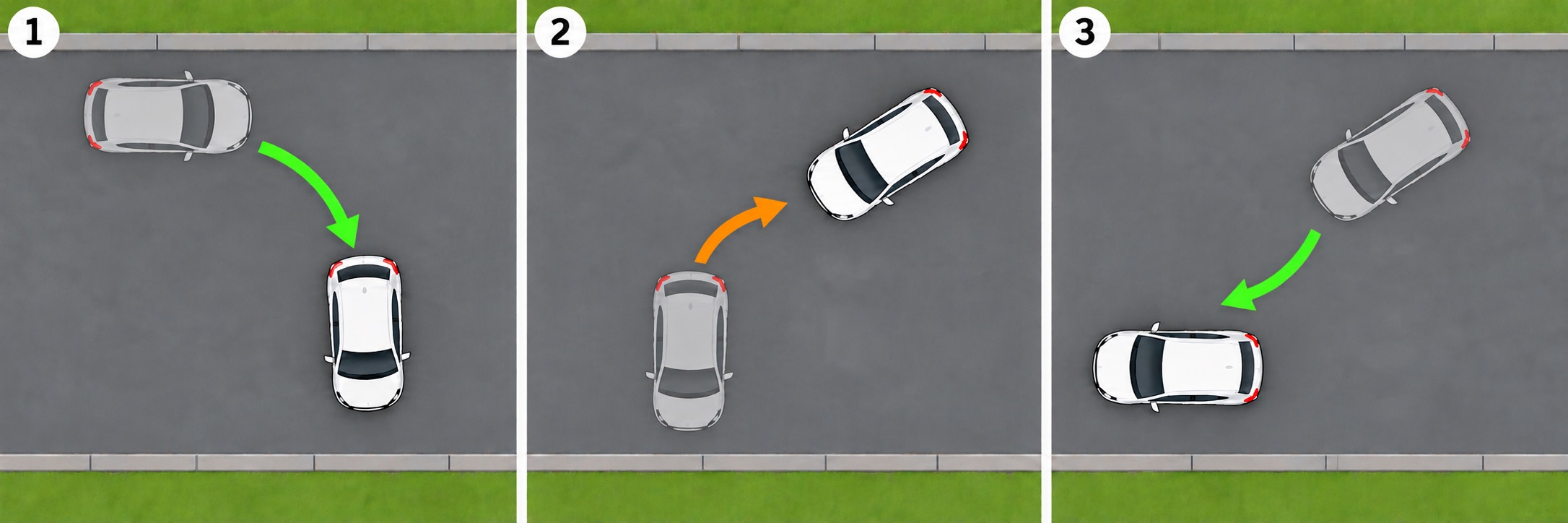
What is a three-point turn? A way to turn around on a road that isn’t wide enough for a U-turn: forward across the road, reverse back, then forward again in the other direction.
- Stop close to the left kerb. Signal right for at least five seconds, check mirrors and your right blind spot.
- Drive forward slowly on full right lock. Stop before the far kerb.
- Check left and right. Reverse on full left lock, checking mirrors and out of the rear and side windows. Stop before the kerb behind.
- Check left and right. Drive forward, steering right, and straighten up in the left lane.
Most people who struggle with the three-point turn aren’t short of room. They run out of steering. The car keeps moving while the wheel is still coming round, and by the time it’s on full lock the kerb is already there. The fix is to go slower than feels necessary, especially in the last metre before each kerb.
Is the three-point turn on the NSW driving test?
It might be. Every NSW test includes a kerbside stop, plus one other manoeuvre. Transport for NSW’s testing officer manual says that’s either a three-point turn, a reverse parallel park or an angle park, and the examiner will tell you which before you start. So you need to be ready for all three.
The examiner won’t chain manoeuvres together. You won’t be asked to start the three-point turn straight from your kerbside stop.
How to do a three-point turn, step by step
1. Stop at the left kerb and look
Pull over close to the left kerb and stop. Before you move off, signal right. In NSW you must signal for at least five seconds before leaving the kerb, so count it rather than flicking the indicator on as you go. Check your mirrors and turn your head for the right blind spot. Then check left and right along the road. The NSW guide asks you to check both ways before each movement of the turn, not just the first one.
2. Forward on full right lock
Move off at a crawl and turn the wheel quickly to full right lock. Keep the speed down so the car is pointing well across the road before you reach the far side. Stop before the front tyres touch the kerb, with a small gap to spare. Thirty centimetres or so is plenty. Some people start bringing the wheel back to the left in the last half-metre, while the car is still rolling, so they’re partly set up for the reverse. That only works if you’re slow enough to do it calmly.
3. Reverse on full left lock
Handbrake on if the road slopes. Select reverse and check left and right again. Reverse slowly, turning to full left lock. Stop before the rear tyres reach the kerb you started from.
While you reverse, keep checking where the car is going: mirrors, the rear window and the side windows. NSW doesn’t expect you to twist round and stare out the back the whole time. The testing officer manual describes it as a mix of checking behind, ahead and to the sides. A reversing camera is fine to use, but not as your only check. Glance at the front of the car as it swings, too, because it moves the other way.
4. Forward and away
First gear or Drive. Check left and right once more and drive forward, steering right, then straighten into the left lane. In the NSW test the turn only counts as finished once you’re travelling in the opposite direction and back in the normal flow of traffic. So keep your speed and observation up until then.
How the NSW test marks it
| What happens | How it’s treated |
|---|---|
| Done in 3 direction changes on a road wide enough for it | Expected |
| More than 3 changes when 3 was possible | Scored down for vehicle control |
| Narrow road | Up to 5 direction changes allowed |
| Not finished in 6 changes | You’re asked to abandon it |
| Using a driveway to turn | Position error, not a fail |
| Light touch or brush against the kerb | Allowed |
| Mounting the kerb | The applicant guide says this is a fail at any time during the test |
Missing the left-and-right check before a movement is marked as an observation error. Not signalling for five seconds before leaving the kerb also costs you. Do it repeatedly across the test and it becomes a fail item on its own.
If a car, cyclist or pedestrian comes along while you’re part-way round, stop and let them pass. You’re across the road and in everyone’s way, which feels awkward, but waiting is the right call. Rushing the next movement to clear the road is how people end up on the kerb.
Testing officers are told to pick roads narrow enough that a normal range of cars could do the turn in three to five direction changes, and without many parked cars. So you won’t be sent to a road that’s impossibly tight. But a longer car on a narrow street may really need five, and that’s allowed.
Three-point turn or U-turn?
Transport for NSW puts it simply: you can do a three-point turn when the road isn’t wide enough for a U-turn. A U-turn is one continuous turn. A three-point turn is for when you can’t make it in one go.
Its list of places where you must not make a U-turn is a good guide to where you shouldn’t turn around at all: across a single or double unbroken dividing line, on motorways and freeways, at intersections with a “No U-turn” sign, and at traffic lights unless there’s a “U-turn permitted” sign. In heavy traffic, Transport for NSW suggests going around the block or using a roundabout instead.
Three-point turn FAQ
How many direction changes are allowed in a three-point turn?
On the NSW test, three if the road allows it, and up to five on a narrow road. If you haven’t finished after six, the testing officer will ask you to stop trying.
Can I use a driveway?
It isn’t a fail on the NSW test, but it is marked as a position error. Use the road.
Is touching the kerb a fail?
A light touch or brush is allowed. Mounting the kerb is a fail.
What is a three-point U-turn?
Another name for the same thing: turning to face the other way in three moves because the road is too narrow for a U-turn in one.
Can I use the reversing camera?
Yes. Transport for NSW says cameras and sensors can help, but you still have to check your mirrors and around the car. You don’t need to turn your whole body to look out the rear window.
The other manoeuvre you may get is the reverse parallel park. The parking mistakes that cost marks guide covers how that’s assessed.