How to 90-Degree Park: Backing Into a Parking Space
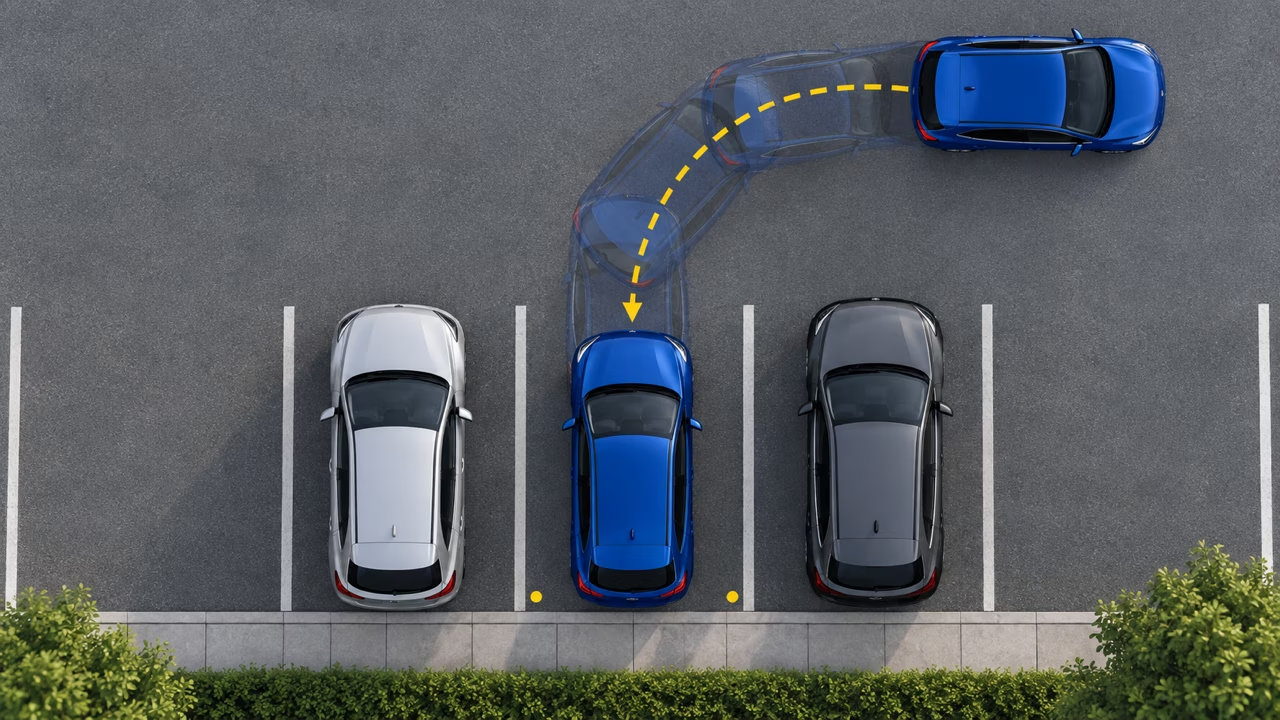
Official sources: Georgia DDS parent/teen guide, DVSA — see Sources. Taking the UK test? See reverse bay parking for the DVSA test.
How do you 90-degree park? A 90-degree parking space sits at a right angle to the aisle, side by side with other cars. The easiest way to get in neatly is to back in, which is called reverse bay parking:
- Drive along the aisle about 5–6 ft (1.5–1.8 m) from the parked cars. Stop when your shoulder is level with the line two lines past your space.
- Look all around, select reverse and turn the wheel to full lock toward the space.
- Creep back, watching the mirror on the space side, until the car is parallel with the bay lines.
- Straighten the wheel and reverse until the back of the car reaches the end of the space.
You can also drive into a 90-degree space front first, and plenty of people do. But backing in is usually neater. The rear wheels steer the car into the gap, so you can turn tighter and end up straighter. And when you leave, you drive out forwards and can see the aisle.
How to 90-degree back park: the two-line method
Back parking into a 90-degree space, or reverse bay parking as it’s called in the UK, is easiest with two reference points: one line on the ground and one mirror. This works when the aisle is a normal width and the spaces either side of yours may have cars in them.
1. Get your distance from the parked cars
Drive slowly along the row, about 5–6 feet (1.5–1.8 m) from the ends of the parked cars. Much closer and the front of your car will swing into them as you reverse; much further and you’ll run out of aisle before you’re straight.
2. Stop two lines past the space
Count the painted lines. Pass the space you want, pass the next line, and stop when your shoulder is level with the line after that, two lines beyond your space. In a small car you may need to stop slightly earlier; in a long one, slightly later. That’s the one thing to adjust once you know your car.
3. Full lock and creep back
Check all around: behind you, the aisle in both directions, and people walking between cars. Select reverse, then turn the wheel all the way toward the space before the car moves much. Reverse at walking pace or slower. Keep an eye on the front corner on the other side, too. It swings out into the aisle.
4. Watch the bay corner in the near-side mirror
As the car swings, look at the mirror on the space side. You’ll see the corner of the space, where its line meets the aisle, and the side of your car closing in on it. What matters is how that gap changes:
- The gap stays at about a foot or more and the car comes round past the corner: you turned at the right time. Leave the wheel where it is.
- The gap keeps shrinking: you turned too early, and the back of the car is cutting into the corner. Stop. Take about half a turn off the wheel and creep back, so the car moves a little further along the aisle before it swings in. Once the gap opens up, go back to full lock.
- The corner stays well away and the car is heading for the next space along: you turned too late or stopped too far from the bay. You can’t fix that by steering harder, because you’re already on full lock. Pull forward, straighten up and start again a little closer to the parking space.
Once you’re past the near corner, glance at the other mirror. That side has the most room at the start and the least at the end, so that’s where the car next door gets close.
5. Straighten up when you’re parallel
When the lines in both side mirrors run parallel with the car, take the lock off and bring the wheels straight. Then reverse slowly until the back of the car is near the end of the space: the curb, wall or end line. If you can’t judge it, stop a little short. A car that sticks out a few inches is better than one that hits the wall.
How to pull forward into a 90-degree space
Georgia’s Department of Driver Services gives the forward method in its parent/teen driving guide:
- Signal, and position the car 5–6 feet away from the space.
- Move forward until your side mirror lines up with the first line of the space.
- Check traffic, then turn the wheel quickly toward the space while keeping your speed down.
- Steer toward the middle of the space and straighten the wheels.
- Stop with the front bumper 3–6 inches from the curb or the end of the space.
The usual mistake going in forwards is turning too early. The rear wheels cut inside the front ones, so the side of your car heads for the car beside the space. The perpendicular parking guide covers the forward method and how to reverse out safely.
Narrow aisle: the 45-degree swing-out method
In older parking garages the aisle can be too tight to reverse in from the normal position. Make room by angling the car first:

- Drive along the row as close as is comfortable to the parked cars, and stop when your rear wheel is roughly level with your space.
- Turn the wheel fully away from the space and drive forward until the car is at about 45° to the aisle, with the back pointing toward the space.
- Reverse, steering toward the space, and straighten up once you’re parallel with the lines.
Check what’s in front of you before you swing out. In a narrow aisle the front of the car gets close to the cars on the other side.
Fixing a crooked bay
- Closer to one line than the other: stop, pull forward a car length with the wheel turned toward the side with more space, straighten, and reverse back in.
- Can’t see the lines: tilt the side mirrors down before you start, so the ground lines are in view. Some cars do this automatically in reverse.
- Not sure where the end is: open your door a little and look down, or get out and look. Nobody minds.
90-degree parking FAQ
What is 90-degree parking?
Spaces at a right angle to the aisle or curb, side by side, as in most parking lots. It’s also called perpendicular parking, or bay parking in the UK. In the US, “perpendicular parking” usually means pulling in forwards; that’s covered in the perpendicular parking guide. Backing in is what the UK calls reverse bay parking.
Is it better to back into a 90-degree space or pull in?
Backing in takes a little more practice, but you end up straighter and you drive out forwards with a clear view of the aisle. Pulling in is quicker but means reversing out past the cars on each side. Follow any signs: some lots ask for one or the other.
When do I turn the wheel when backing in?
Start from your shoulder level with the line two lines past your space, then go to full lock. After a few tries, use the near-side mirror to adjust: if the corner of the space gets closer and closer, you’re turning too early; if it never gets close, you’re turning too late.
Is bay parking on the driving test?
In the UK it can be. The DVSA examiner asks for one reversing manoeuvre, and parking in a bay (driving in and reversing out, or reversing in and driving out) is one of the options. US road tests vary by state, so check your state’s handbook.
Sources
Try it in the simulator
The reverse bay drill is a 90-degree space you back into, with coaching in Practice mode and no prompts in Exam mode. It uses one fixed car, so re-check your reference points in your own vehicle.
Open the reverse bay drill