Perpendicular Parking: How to Pull Forward Into a 90-Degree Space
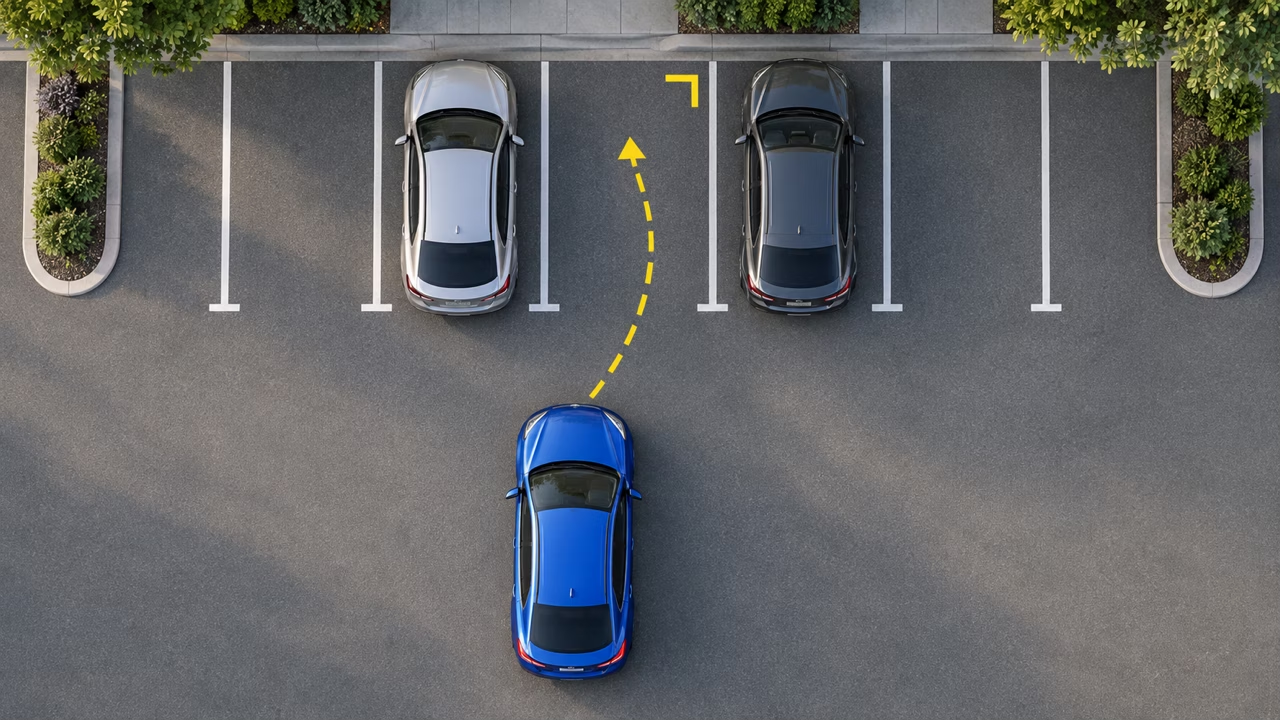
Official source: your local testing authority’s driver handbook. Taking the UK test? See forward bay parking for the DVSA test.
What is perpendicular parking? Parking at 90° to the aisle or curb, in a space side by side with other cars — the layout of most parking lots. In the UK it is called forward bay parking. To pull in forwards:
- Drive slowly along the far side of the aisle, about 2–2.5 m (7–8 ft) from the parked cars.
- When your side mirror lines up with the first line of the target space, turn the wheel to full lock toward it.
- Creep in, checking both front corners; straighten the wheel as soon as the car is parallel with the lines.
- Stop when your front bumper reaches the end of the space.
Driving front-first into a perpendicular space looks easier than reversing in, but it is where a lot of door and bumper scrapes happen. When you steer forwards, the rear wheels follow a tighter line than the front ones and cut the corner — so if you turn too early, the side of your car swings into the vehicle beside the space. The fix is a wide approach and a late, decisive turn.
How far from the parked cars should you be?
The single biggest key to successful forward bay parking is maximizing your aisle approach width before turning:
- Drive Away from the Bay: Position your vehicle as far to the opposite side of the parking aisle as possible (ideally leaving 2.0 to 2.5 meters of clearance between your car and the row of parked cars).
- Maintain Low Speed: Crawl at walking speed in 1st gear (or D) so you have ample time to rotate the steering wheel without overshooting.
When do you turn into a perpendicular parking space?
Reference Point: The First Bay Marking Line
As you approach your target bay, look out your side window:
- Line Alignment: Keep moving forward until your side wing mirror aligns vertically with the first painted line of your target parking bay (or the bumper line of the car parked immediately before your bay).
- Steer Full Lock: At this exact reference mark, rapidly turn the steering wheel full lock toward the target bay.
- Creep Forward: As the front nose enters the bay, continuously monitor your front wing mirrors to ensure clearance from vehicles on both left and right sides.
- Straighten Wheels: Once your car body is parallel with the bay marking lines, quickly straighten the steering wheel (1.5 turns back) and glide forward until your front bumper is aligned with the front boundary line.
How do you back out of a perpendicular space safely?
Exiting a forward-parked bay requires extra caution because neighboring vehicles obstruct your rear side vision:
- Reverse Straight First: Shift to Reverse and back out in a straight line until your rear B-pillar / rear wheels align with the rear bumpers of the adjacent parked cars.
- Do NOT Turn Wheels Early: Turning the steering wheel before your front bumper clears the adjacent car will cause your front fender to scrape their rear bumper.
- Turn Full Lock & Scan: Once your front bumper clears their rear lights, steer full lock while continuously scanning both directions for moving aisle traffic.
Perpendicular parking FAQ
Is it better to pull forward or back into a perpendicular space?
Backing in takes a little longer but makes leaving safer, because you drive out forwards and can see the aisle. Pulling in forwards is quicker but means reversing out blind past the neighbouring cars. Some car parks require one or the other, so follow the signs. Backing in is covered in how to 90-degree park.
Why does my car end up crooked in the space?
Usually because you turned too early (the car points at the left or right line) or straightened too late. Stop, reverse a little in a straight line, and correct while moving slowly rather than steering hard with the car stopped.
How far do I pull into the space?
Until the front of the car reaches the end of the space, with your rear bumper clear of the aisle. If there is a curb or wall ahead, stop before the front bumper overhangs it.
Try it in the simulator
The forward bay drill lets you practise your turn-in point and straightening up inside the lines. It uses one fixed car, so re-check your reference points in your own vehicle.
Open the forward bay drill